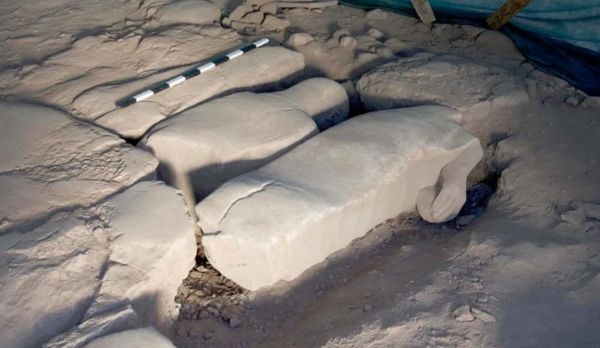
Archaeologists discovered the roughly 2,500-year-old sculpture of a young man while conducting excavations at Sardis in western Turkey. The artwork reflects the different cultures that wielded control over the city in the first millennium B.C.E.
Some 2,500 years ago, an artist in what is now western Turkey sculpted a larger-than-life statue of a young man holding a piece of fruit in his right hand, likely a quince slated to be offered to the gods. Hundreds of years later, after the region came under Roman rule in 133 B.C.E., the sculpture found a new lease on life as a paving stone. Workers broke the marble figure in two and placed its halves facedown, inadvertently preserving them for centuries.
Archaeologists discovered the repurposed statue while excavating Sardis, the onetime capital of the ancient kingdom of Lydia. According to the Turkish Ministry of Culture and Tourism, the seven-foot-tall sculpture dates to between 470 and 450 B.C.E., about a century after the Achaemenid Persians wrested control of Sardis from the Lydians. At the time, Sardis served as the capital of an Achaemenid province, or satrapy.
The young man’s appearance is unusual for the period, reflecting a blend of stylistic influences. “It’s a wonderful piece, and we’re still kind of astounded and a bit perplexed by it,” Nicholas Cahill, field director of the Sardis Expedition, tells the Art Newspaper’s Hadani Ditmars.
Researchers plan to examine the sculpture’s surface for traces of paint.
Researchers plan to examine the sculpture’s surface for traces of paint. Turkish Ministry of Culture and Tourism
The sitter’s long hair and posture are reflective of older sculptural traditions from the sixth century B.C.E., but his facial features and hands are more in line with contemporary works from the first half of the fifth century B.C.E. His clothing, meanwhile, is distinctly Lydian, featuring a thick himation, or outer wrap, over a thin chiton shift, with a striped garment underneath.