A scientific study published in 2024 has outlined that Iranian plateau served as a central hub for Homo Sapiens after the dispersal of modern humans (Homo Sapiens) from Africa. The study is available in the below link:
Vallini, L., Zampieri, C., Shoaee, M.J. et al. (2024). The Persian plateau served as hub for Homo sapiens after the main out of Africa dispersal. Nature Communications, 15, 1882. DOI: https://doi.org/10.1038/s41467-024-46161-7; File available in pdf
As noted by Vallini and fellow researchers, it is well know that (based on genetic, fossil and archaeological studies) that anatomically modern humans dispersed out of Africa approximately 70–60 thousand years ago. However a new finding is that the Iranian Plateau served as a major ancestral “Hub” population of Homo sapiens likely persisted for roughly 20,000 years in or around the Persian/Iranian Plateau before later expansions that populated the Eurasian landmass.
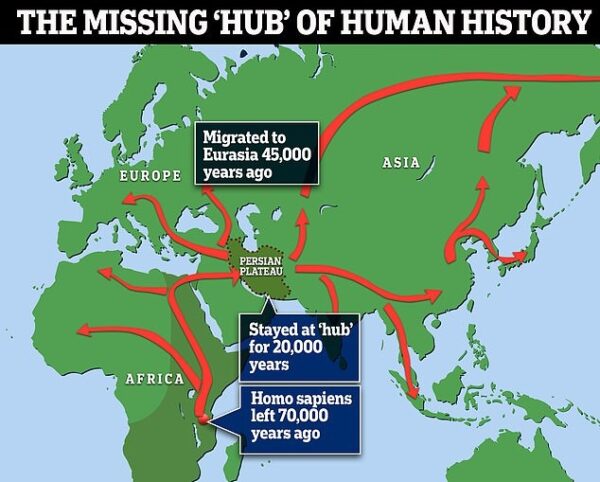
Map-Info graphic obtained from the Quroa outlet based on the Vallini et al study (Source: Quora).
The authors make the following critical point: the Iranian Plateau may have been the long-term demographic and cultural incubator of the populations that later spread across Eurasian landmass: “the time elapsed as a single Hub population might have served as an incubator for the development of cultural innovations…” (Vallini et al., 2024, p.7).
Put simply, after leaving the African mother continent, anatomically modern humans populations may have settled in the “Hub” of the Iranian Plateau. It was during this prolonged sojourn in the Iranian Plateau (approximately 60–45 thousand years ago – approx. 25 thousand years during the late Pleistocene era) when modern human developments in technology and culture may have accumulated. These possible developments within the “incubator” of the Iranian Plateau were then to be spread across the Eurasian landmass from 45,000 years ago.
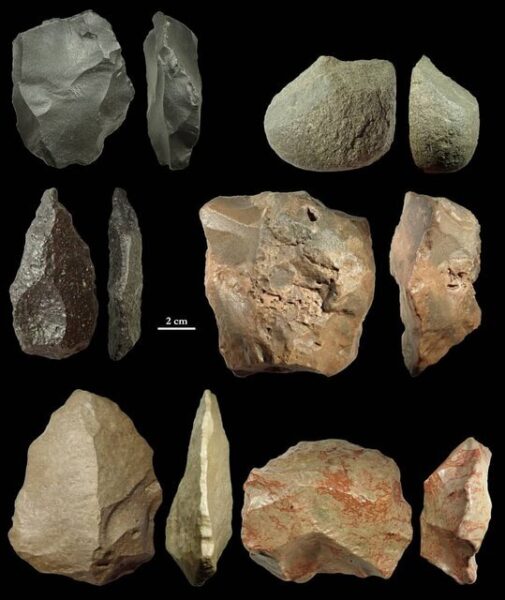
As reported by Afshin Majlesi of the Tehran Times (May 9, 2021): “A new study reinforces a hypothesis that the Iranian plateau was like a bridge between East and West during the Pleistocene epoch, which began about 2.6 million years ago and lasted until about 11,700 years ago” (Image and description: Tehran Times).
It was during these Upper Paleolithic expansions when cultural (symbolism, rock arts, etc.) and technological innovations were to spread across the Eurasian landmass. This may help in explaining the subsequent technological and cultural developments associated with behaviourally modern humans across the Eurasian landmass.
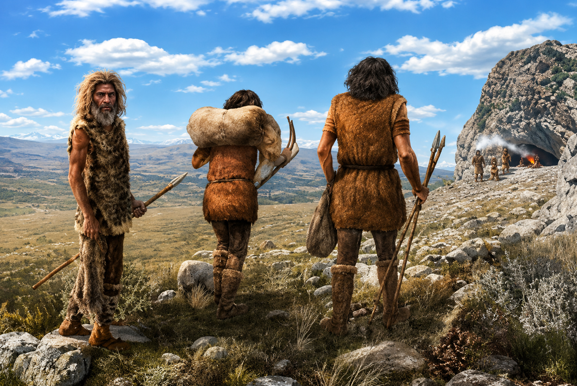
A reconstruction of Paleolithic-era humans at the Paleolithic site of the Khorramabad valley caves in Western Iran’s Lorestan region 60-45,000 years ago (Original Image Source: Tehran Times). Note that Iran’s Khorramabad Valley Paleolithic Cave sites have been added to UNESCO’s World Heritage List.
This critical Vallini study raises the level of importance of the ancient Iranian Plateau into having possibly (or potentially) enacted an important role in the later genesis of cultural and technological developments in the Eurasian landmass.
Related posts:
- Bridge between East and West: Iranian plateau in the Pleistocene Era
- Article on Persian Heritage journal publishes article on links between Germania and ancient Iranian Peoples
- Kaldar cave in Iran estimated to date over 63,000 years
- Archaeologists find New Evidence of Paleolithic Era in Iranian cave
- Traces of early Humans discovered in Iran
- Two New courses for Fall 2018
- New Book: The Sassanians: Origins of an Empire
- Academic Article on Iranian Women at War
- Spanish Military History Journal Interview with Kaveh Farrokh
- Fall 2019 Iranian Studies Initiative Lectures at the University of British Columbia
By Dr. Kaveh Farrokh|May 14th, 2026|Ancient: Prehistory – 651 A.D., Anthropology, Archaeology, Culture, Heritage, Iran and Africa, Iran and Caucasia, Iran and Central Asia, Iran and China, Iran and Europe, Iran and India, Iran and Japan, Iran and Korea, Iran and the Persian Gulf, Iran and Turkey, News, Pleistocene, Technology|Comments Off