 4000-year-old boat excavated near the ancient city of Uruk
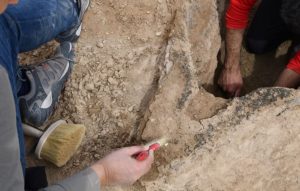
A team of archaeologists from the Iraqi German Mission of the State Board of Antiquities and the Orient Department of the German Archaeological Institute have excavated a 4000-year-old boat near the ancient city of Uruk.
Uruk, also known as Warka was an ancient city of Sumer (and later of Babylonia), situated on the dried-up ancient channel of the Euphrates River.
Uruk played a leading role in the early urbanisation of Sumer in the mid-4th millennium BC, emerging as a major population centre until it was abandoned shortly before or after the Islamic conquest of AD 633–638.
The boat was first discovered during a study of the Uruk-Warka environs in 2018, where it was photogrammetrically documented, however, the threat of road traffic near the site has led to a rescue excavation to preserve the remains.
Constructed from reed, palm leaves and wood, the boat was covered in bitumen, a substance produced through the distillation of crude oil that is known for its waterproofing and adhesive properties.
Measuring 7 metres in length and 1.4 metres wide, the archaeological context shows that the boat sank on the banks of a river around 4000-years-ago and became buried in layers of sediment.
In accordance with Iraqi antiquities law, it was taken to the Iraq Museum in Baghdad for further scientific study and conservation.
A team of archaeologists from the Iraqi German Mission of the State Board of Antiquities and the Orient Department of the German Archaeological Institute have excavated a 4000-year-old boat near the ancient city of Uruk.
Uruk, also known as Warka was an ancient city of Sumer (and later of Babylonia), situated on the dried-up ancient channel of the Euphrates River.
Uruk played a leading role in the early urbanisation of Sumer in the mid-4th millennium BC, emerging as a major population centre until it was abandoned shortly before or after the Islamic conquest of AD 633–638.
The boat was first discovered during a study of the Uruk-Warka environs in 2018, where it was photogrammetrically documented, however, the threat of road traffic near the site has led to a rescue excavation to preserve the remains.
Constructed from reed, palm leaves and wood, the boat was covered in bitumen, a substance produced through the distillation of crude oil that is known for its waterproofing and adhesive properties.
Measuring 7 metres in length and 1.4 metres wide, the archaeological context shows that the boat sank on the banks of a river around 4000-years-ago and became buried in layers of sediment.
In accordance with Iraqi antiquities law, it was taken to the Iraq Museum in Baghdad for further scientific study and conservation.