We believe that all cultural, historical and natural heritage, wherever they are should be preserved. LEARN MORE
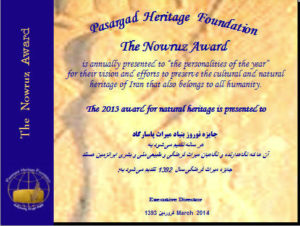
Nowruz

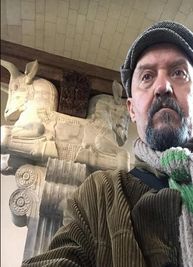
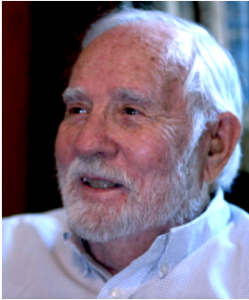
Dr. Fred Harrington, recipient of the Pasargad Heritage Foundation’s Nowruz Award

Brief Biography, Fred A. Harrington, Jr

Dr. Fred A. Harrington was born in Colorado, and at the age of 10 the family moved to Albuquerque, New Mexico, where his father worked as a construction engineer. He attended the University of New Mexico in pre-forestry and then transferred to Colorado State University, where he obtained a degree in Wildlife Biology in 1959. After graduation, he was employed as a big-game biologist by New Mexico Game and Fish Department. Three years later, faced with the military draft, he chose to enter the Aviation Cadets program, where after a year of training he became a 2nd Lieutenant with a flight navigator rating.

He served 5 years in Military Airlift Command during the Vietnam War era, attaining the rank of Captain and then returned to Graduate School at Colorado State University where he studied Bighorn Sheep in Rocky Mountain National Park for my PhD.

In 1970 Harrington was interviewed by Eskandar Firouz )head of the Hunting and Fishing Organization), for a position in Iran, where he served for 7 years in a wide range of natural resource activities. Among his chief accomplishments was completion of the National Report on the Environment for the Stockholm Conference and subsequently was asked to prepare a plan for creation of the Iran Department of the Environment. The plan was passed by Parliament in 1972, and he served as head of the Division of the Natural Environment, where he continued to conduct and supervise field activities, prepared a wide range of scientific and popular publications and worked with several film groups to document the activities of the Department.

Harrington returned to the United States in 1977 and worked as Western Regional Land Steward for the Nature Conservancy before setting up his own environmental consulting firm. He was hired by Ebasco Engineering to perform the Ecological Monitoring Program for the cleanup of Rocky Mountain Arsenal, allegedly the most polluted spot on the planet. Harrington was then engaged by the Department of Energy to perform the feasibility studies for cleanup of Rocky Flats Nuclear Facility near Denver. He subsequently served as head of the Ecology Division, monitoring the cleanup. Both Rocky Mountain Arsenal and Rocky Flats Nuclear Facility ultimately became National Wildlife Refuges.

Harrington and his wife then returned to our roots in the Pawnee Grasslands of northeast Colorado where thay restored an historic hotel and ran a “birder’s bed and breakfast” which thay named the Plover Inn.
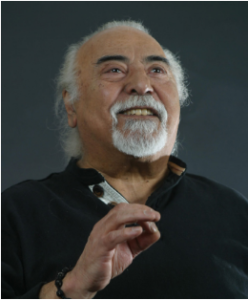
Esfandiar Monfaredzadeh, recipient of the Pasargad Heritage Foundation’s Nowruz Award.

Esfandiar Monfaredzadeh, musician and composer

Esfandiar Monfardzadeh was born in 1941 in Tehran, Iran. From an early age, he learned playing various instruments, and from the age of thirteen, he played the tambourine, accordion, and dulcimer in school art programs. At fifteen he played with a group in the Children’s morning program of Iran’s national radio. From the age of sixteen, he worked and played instruments in cafes and theaters in Tehran.

Monfardzadeh was nineteen years old when he started composing songs and composed a song for the Radio Iran Youth Orchestra. He went on to compose more than ten songs in the next three years. Along with writing songs, one of Monfardzadeh’s major interests was writing soundtracks, and he regularly checked with Iran’s film studios at the time to pursue any possible opportunity.

In 1967, he started a degree in music at the Faculty of Fine Arts in the field of music, but after about two and a half years, he dropped out of the university program.

It was at the opening ceremony of the same college that he arranged and conducted the music of the “Great Student Orchestra of the University of Tehran” (sixty musicians and fifty choirs) for the opera “Conquest of Babylon” (composed by Reza Narvand). This opera was held in the presence of the King and Queen of Iran.

It was from 1969 onwards that he was commissioned by various studios to write and record soundtracks, arrange lip-syncing songs, compose melodies and perform various songs. It was at that time that composing and arranging the full soundtrack for a movie called “Ghaisar” made him famous.

In 1971, he received the award for best soundtrack for it, and a year later, he received the award for best soundtrack again for composing and arranging the soundtrack of another film called “Reza Motori”. In that film, for the first time, he used “song” for the soundtrack.

While in Iran, he composed more than hundred songs, most of which were among the most popular songs of the time. He also composed soundtracks for tens of films. His reputation as soundtrack composer greatly helped the popularity and sales of films.

Monfaredzadeh left Iran for the United States in one year after the Islamic Revolution, to protest the persecution of dissidents. He has not returned to Iran since then and during this time he has composed about 20 songs and soundtracks.

Elahi Boghrat, recipient of the Pasargad Heritage Foundation’s Nowruz Award.

Elahe Boghrat

Elahe Boghrat was born in 1957 in Sari (northern Iran) to a cultural family. She began her university studies at the National University of Iran (Tehran) in the field of jurisprudence and graduated in 1975, but did not pass the 14-units course in Islamic education (which was made compulsory after the revolution). As a result, the university refused to grant her a degree for years.

Boghrat became a member of the Communist Organization of the People’s Fedayeen in 1980 and had a political and semi-secret organizational life until 1989. In 1990, she intellectually and in practice left the Fadaiyan organization and secretly and illegally left Iran and fled to Germany. She received her refuge status (refuge asylum) in Germany, and in 1993 started studying at the University of Berlin, where she received a bachelor’s degree in political science. After graduation she started working full-time as a journalist.

Her first job was launching a website called “Journalist” and since 1995 she has been writing analytical-political articles for Kayhan London (an independent news magazine) and since 2013 she has been the editor in chief.

Elahe Boghrat also has two collections of short stories called “Feminine” and “Crazy House Notes” and a book called “Names and Looks” which is a collection of her conversations with literary and artistic figures.


Happy New Year 2021!

Dear Friends, and Supporters of World Cultural Heritage Voices.

On behalf of our colleagues and volunteers at WCHV, and on the occasion of the Global New Year of 2021, we would like to extend our regards and best wishes for a Happy New Year.  Thank you for your support of WCHV, which has been so instrumental in achieving our goals and mission.

Pasargad Foundation Awards “Personality of the Year 2020”

The Pasargad Heritage Foundation Presents:

The Nowruz Award March 21, 2020.

This press release has been published by the Pasargad Heritage Foundation to the Personalities of the Year for their vision and efforts to preserve the national, cultural, historical, and natural heritage of Iran that also belongs to all humanity.

Dr. Nastour Rakhshani, a painter and art researcher, receives the Nowruz Award for
“Personality of the Year in Art and Culture” for:

  • A lifetime of tireless work as a valued, admired, and irredentist artist at home and in asylum
  • Striving to gain a status similar to that of European artists
  • His unique style, combining the art of both Eastern and Western paintings
  • Representing Iran and Iranians at major European exhibitions
  • Many years of working to introduce Iranian art and culture abroad
  • Representing the history and culture of ancient Iran through painting national figures and displaying Iran’s works of architecture and civilization

Dr. Nastour Rakhshani Bio:
Dr. Nastour Rakhshani was born in Tehran in 1947, where he spent his childhood and
adolescence.

Read entire article on this page

Professor Hooshang Ziaei, a well known Iranian expert on wildlife and environmental and natural resources, a scientific member and advisor at the Iranian Museum of Natural Resources, and a lecturer in the fields of wildlife management and biology at Iranian universities, is the recipient of this year’s “Personality of the Year in the Field of Natural Resources” and the recipient of the Nowruz Award for the following achievements:

  • Over 50 years of continuous efforts to protect and preserve Iran’s natural heritage and environment
  • Researching and publishing more than a dozen valuable books and articles related to Iran’s natural heritage
  • Educating students, experts, and enthusiasts about natural heritage and the
    environment, and preparing them for the challenge of tackling further destruction of Iran’s environment
  • Helping to preserve Iran’s Museum of Natural Resources and Wildlife
  • Significant efforts to prevent illegal hunting practices

Professor Ziaei’s Bio:
Professor Ziaei began his research and development work several years before the Iranian revolution in 1979, managing and overseeing projects such as rescuing and preserving the Persian deer and lion as well as the International Asian Cheetah Conservation Project, for over forty years.

Read entire article on this page

Dr. Mohsen Banaei (Mazdak Bamdadan), a researcher, historian, author, and physician, is the recipient of the “Nowruz Award for Expert of Cultural Heritage of the Year” for the following achievements:

  • Years of effort towards learning different languages to gain knowledge and understanding of the history of religions
  •  Collecting authoritative research and works related to Iranian history and culture
  • Having a clear and present view of the history and culture of Iran and Islam
  • Utilizing a rational and critical approach towards those who have an antagonistic
    view of pre-Islamic history
  • Unparalleled courage in telling historical facts in the context of scientific
    historiography
  • Publishing a valuable book, The Dark Abyss of History, and presenting unique
    findings on one of the most important Iranian religions for the first time in the
    Persian language

Dr. Mohsen Banaie’s bio:
Dr. Mohsen Banaie was born on May 22, 1965 in Tehran, Iran. He spent most of his
childhood in the Iranian province of East Azerbaijan, before he later moved to Tehran.

Read entire article on this page